
Paris in July, 2025 - Literary homes/meme
Updated: Oct 9, 2025
Thank you to Emma @ Words and Peace who is hosting this event this year as well. We are already guided into the various themes of this year. Head over to Emma's website for more information.

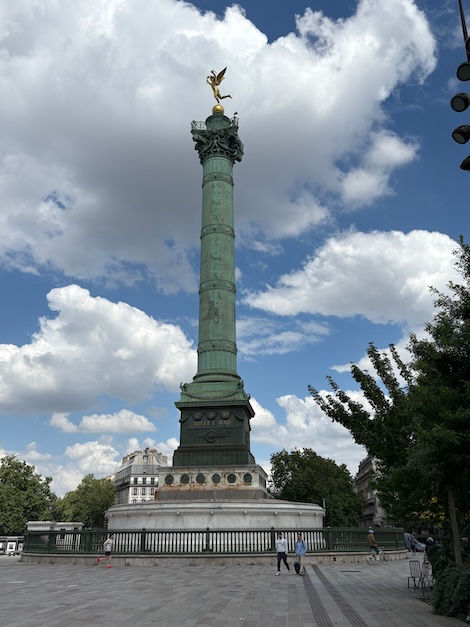
The great thing about Paris is when you decide to visit a museum, a place or do whatever you have in mind. Once done, you just have to check out Google maps and you will find several other interesting places to visit. This was the case when I visited the Bastille. Well, the original Bastille is gone today, left is only a square and a park.
The Bastille
As you know it was once a fortress, known as the Bastille Saint-Antoine. For most of its history it was a state prison. On 14 July 1789 it was stormed during the French Revolution. After the destruction very little remained of the fortress. What remained was later demolished and replaced by the Place de la Bastille. Today a rather peaceful place. At the centre stand the July Column, commemorating the 1830 revolution. On the top is the famous statue Génie de la Liberté by Augustin Dumont.
Maison de Victor Hugo
It did not take too much time, so I was eager to visit something else. I checked Google maps and found that Victor Hugo once lived nearby, when he returned to Paris from his exile in Jersey and Guernsey. We visited his house in Guernsey some years ago and I was eager to see how he lived in Paris. His house in Guernsey is a little bit of a horror house. He decorated it himself, and it is a dark place, with rustic furniture and I could not imagine to live there.
His flat in Paris is another matter. Situated at the beautiful Place des Vosges in the Marais district, it is the oldest planned square in Paris. with a park in the middle and surrounded by beautiful noble houses. It is one of the royal five squares in Paris. A fashionable place to live. Victor Hugo lived her from 1832 to 1848. In 1903 the flat was made into a museum.

.It is not decorated with furniture from Hugo’s time, but decorated with pieces from that time. The family of Hugo has also generously donated many items to the museum. It was interesting to walk around the rooms, which were much nicer than his house.
The Picasso Museum
Coming out of the museum and walking around the square admiring the buildings surrounding it, it was time for another map. I discovered that there is a Picasso museum nearby, so started walking in the direction. It showed me another nice area of Paris, with its small streets with shops and restaurants, and small parks everywhere. I found the museum after a somewhat labyrinthine walk through the small streets.
The Museum was another surprise. I am not that much of a fan of Picasso, but when I followed his career from early years through his life, I am much impressed by the man. He never seems to have settled with what he was doing, always developing his art along the way. If you ever are in Paris you have to visit the museum. It gives such a good insight into his life and artistic work.


Maison de Honoré de Balzac
Another day, another literary home. I took the metro to come to Balzac’s house which is situated a little bit outside the Seine. The metro station before my destination was the Eiffel tower. It turned out there was something wrong with the doors of the wagons, so we all had to leave the train. I had not intended to go to the Eiffel tower since I have been there before. But, when fate takes you this way, you just have to say thank you.
I did not go very close but stayed on the route to Balzac. Still, I got closer than before and got a nice picture from the bridge over the Seine.

I continued through a very nice area of apartment houses, had to go up a lot of stairs to come to the next level. It was tough.

Once letting my breath come back to normal, I continued along the road. All houses seemed to be rather younger than Balzac, and when I saw the modern entrance I was wondering what was going on. I went inside, it was for free, and walked down the stairs and came into a wonderful, peaceful garden, where people were scattered here and there, reading, drinking coffee or just relaxing. At the end of the garden was a small house which turned out to be where Balzac used to live.
It turned out that the house was over three floors and what you see from the garden is the top floor. From here you have a nice view over Paris, although in his days, it must have been pure countryside here.


Even if the house was not as it was when Balzac lived here, it was a nice remembrance of his time. I have not read a lot of his books, only Père Goriot which I did like. His most famous writing is that of La Comédie Humane.

He was an inspiration to writers of his time and beyond. He has been compared to Dickens, although I must say I think his books are not as thick as Dickens. Richard Lehan, states that "Balzac was the bridge between the comic realism of Dickens and the naturalism of Zola". Even Flaubert was influenced by Balzac and wrote: “What a man he would have been had he known how to write!” Balzac put attention to detail and depictions of bourgeois life. Even Marcel Proust adored Balzac and studied his works.

Even Henry James was affected by Balzac, and he was sad about the lack of contemporary attention paid to Balzac. I guess that is often the case. Artists get more praise when they are gone. Just look at Van Gogh. James wrote: “Large as Balzac is, he is all one piece and he hangs perfectly together.” Just make me want to read more of Balzac.
It surprises me a little to see a Picasso museum in Paris. I did go to one in Barcelona years ago and loved it!
Lovely random discoveries! I actually didn't know about Balzac's house. And La Comédie humaine is the whole group of his works. Le Père Goriot is I think the 22n book of the first part